
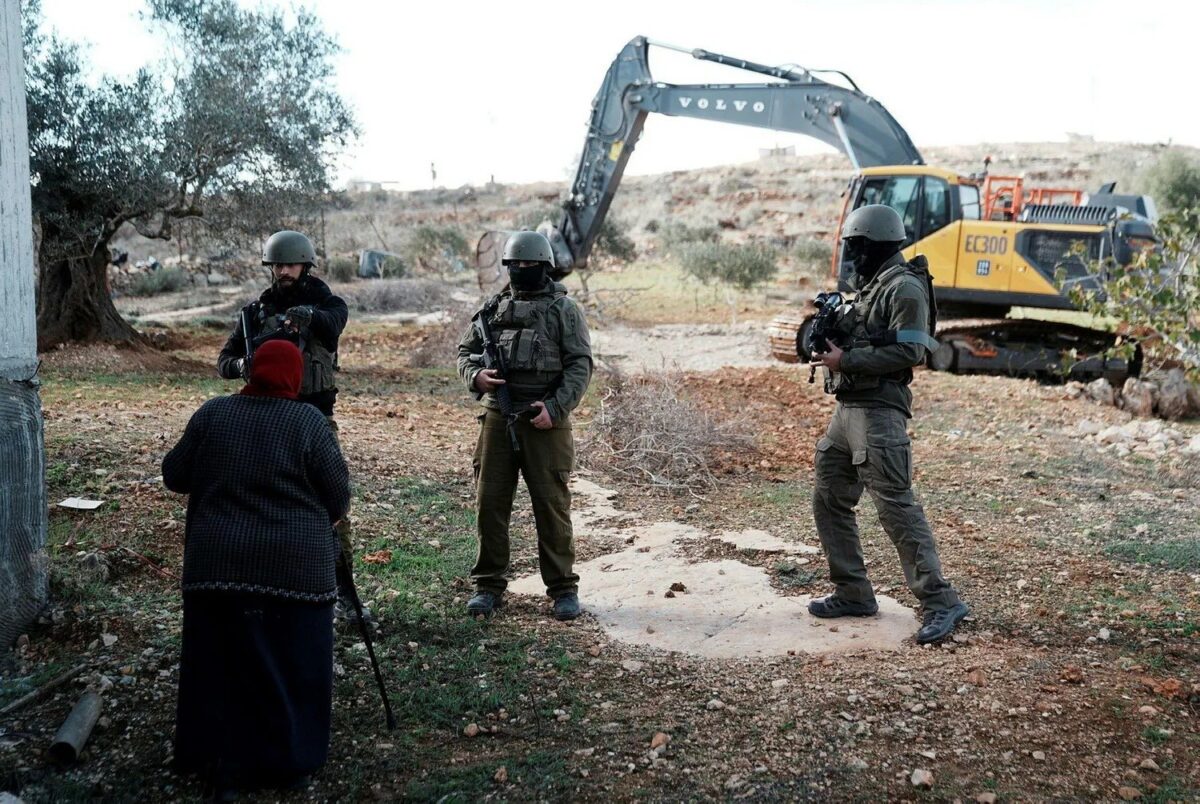
Documentation of Israel’s aggression against farmers and the agricultural sector during the month of November
The current olive harvest season in the occupied West Bank has seen the highest level of illegal settler attacks in five years. October 2025 recorded the highest monthly number of Israeli settler attacks since OCHA began documenting such incidents in 2006. Palestinians all around historic Palestine stated that this is the worst olive harvest in collective memory.
Settler militias and the occupation army have carried out a total of 2,144 attacks against Palestinians, their land, and property.
The olive harvest season has transformed from a traditional agricultural event and ritual into an economic and humanitarian struggle for Palestinians. This struggle is happening within and adds to an already existing context of Israel’s genocide on Gaza and where three main sources of income for Palestinians are collapsing:
- The delayed or non-payment of salaries for a large segment of Palestinian Authority (PA) public sector employees
- The inability of tens of thousands of workers to reach their jobs inside Israel
- The decline in trade between the West Bank and Israeli cities
This has made the olive harvest one of the last remaining sources of income for tens of thousands of families but it has been the most difficult and dangerous in recent decades. With 110,000 farmers in the occupied West Bank directly profiting from the olive harvest and another 50,000 people earning much of their livelihood from working with the trees and produce, between a quarter and a third of the Palestinian population of the occupied West Bank is affected by this season.
Israel’s attacks during this season have been the most violent due to the exploitation of the current genocide by the army and settlers in carrying out their attacks, supported by many policies and legislation that promote cases of settler terrorism, especially the:
- Closure of cities and villages
- Supply of weapons to settler militias
- Exemption from accountability and trial
- Denial of ‘permits’ for farmers to access their lands (According to the UN, no requests for access to Palestinian land inside or within 100-200 metres of settlement boundaries in the northern West Bank have been approved, through “prior coordination” with Israeli authorities)
- Declaration of ‘closed military zones’ on agricultural lands
Israel’s systematic ecocide has been ongoing and part of the Zionist project. Israel has destroyed approximately one million olive trees in the occupied West Bank since 1967. From the beginning of the genocide until today, it has destroyed 56,077 trees. In Gaza, only 100,000 out of the one million trees that existed before the genocide remain standing. Israel also destroyed 35 out of 40 olive presses.
This season, Israel’s destruction of the Palestinian agriculture and economic sector includes:
- Burning of agricultural fields (up until November 11, 2025, more than 700 burning incidents were documented since October, 2023).
- Cutting, uprooting, destroying, poisoning trees
- Theft of crops before or after harvesting
- Theft of agricultural tractors or any harvesting equipment
- Theft of animals used by farmers to transport olives from the fields to their homes or the presses
- Preventing farmers/harvesters from reaching their land
During November, settler militias carried out 485 acts of vandalism and theft of Palestinian property, with the help of the occupation army, causing the uprooting, destruction, and poisoning of 1,986 trees, including 466 olive trees, in the governorates of Nablus (1,260 trees), Ramallah (381 trees), Salfit (135 trees), Hebron (100 trees), Qalqilya (70 trees), and Jenin (40 trees).
This year’s olive harvest was already going to be poor, with severely limited rainfall, but these attacks made it drastically worse. According to Ismat Quzmar, economic researcher and the external relations officer of the Palestine Economic Policy Research Institute (MAS) in Ramallah, states that this year is on track to produce only 7,000 or 8,000 tonnes of olive oil – about a quarter of last season’s 27,300-tonne yield and a third of the annual average of 22,500 tonnes. The olive oil has not been exported as usual as it hasn’t even covered the local market needs. The available olive oil is very expensive and Palestinians in the occupied West Bank are finding imported oil from Tunisia or Syria less expensive.
This year’s olive harvest shows warning signs of the effects on Palestinian social fabric. Harvesting now requires security arrangements: groups advance while others monitor and roles are divided between men and women. In villages near newly established settlements, the need for Palestinians to watch out for attacks has catastrophically increased. This shift from a social ritual to a quasi-military operation reflects the depth of the current crisis facing olive harvesters in the occupied West Bank this year.
Even for journalists and international volunteers, the risk of being directly and physically attacked is continuously present. Settler militias infiltrate Palestinian and international social media groups to learn about planned events, such as bringing in international solidarity activists to help with the olive harvest. They then plan their attacks accordingly. In late October, two Jewish-American women who joined in the olive harvest in the village of Burin were deported by Israeli authorities (previously 32 volunteers were also deported) and banned from entering occupied Palestine for 10 years. On November 4, settlers and the occupation army flew a drone that struck and injured a volunteer during one olive harvest, and fired shots in the air next to the volunteers. On November 8, settler militias attacked and injured 3 paramedics and 3 journalists during an olive-picking event for farmers and international solidarity activists in the town of Beita, south of Nablus. Among the injured journalists was Ranin Sawafṭa from Reuters Agency, who violently beaten by the settlers.
Annexation of the occupied West Bank: the ultimate goal is land grab, ethnic cleansing, and further colonization
- First Tool of Land Grab: Military Orders
On October 22, 2025, the Israeli occupation authorities issued a series of military orders targeting vast areas of Palestinian land in the occupied West Bank. These orders aimed to prevent Palestinians from approaching or entering their lands adjacent to settlements and outposts to harvest olives in various governorates of the occupied West Bank.
According to an analysis by the Applied Research Institute – Jerusalem (ARIJ), 96 military orders were issued, targeting vast areas of olive groves located near Israeli settlements and outposts throughout the occupied West Bank. The Jenin, Jerusalem, Qalqilya, and Ramallah governorates were the most heavily targeted.
The orders also stipulated that entry was restricted to those who obtained permits to access the land solely for the purpose of harvesting and tending the olive trees. The military order is valid until December 31, 2025. This is a recurring policy aimed at gradually seizing Palestinian land through temporary restrictions, gradually leading to permanent closure. These Israeli orders do not include the isolated lands west of the Apartheid Wall, which have become practically cut off from their owners.
- Second Tool of Land Grab: Outposts
During November, settler militias established 19 new settlement outposts, most of which are agricultural and pastoral in nature. These outposts are distributed as follows: five settlement outposts on land in the Nablus governorate, three outposts each in Hebron, Jerusalem, Ramallah, and Al-Bireh, two outposts in Tubas, and one outpost in Qalqilya. These outposts were approved on December 11 by the Israeli ‘security’ cabinet.
- Third Tool of Land Grab: ‘Closed Military Zones’
Israeli forces have announced 25,000 dunams (2,500 hectares or 6,177 acres) of olive groves were announced as closed military zones in the occupied West Bank.